
Last updated October 16, 2026
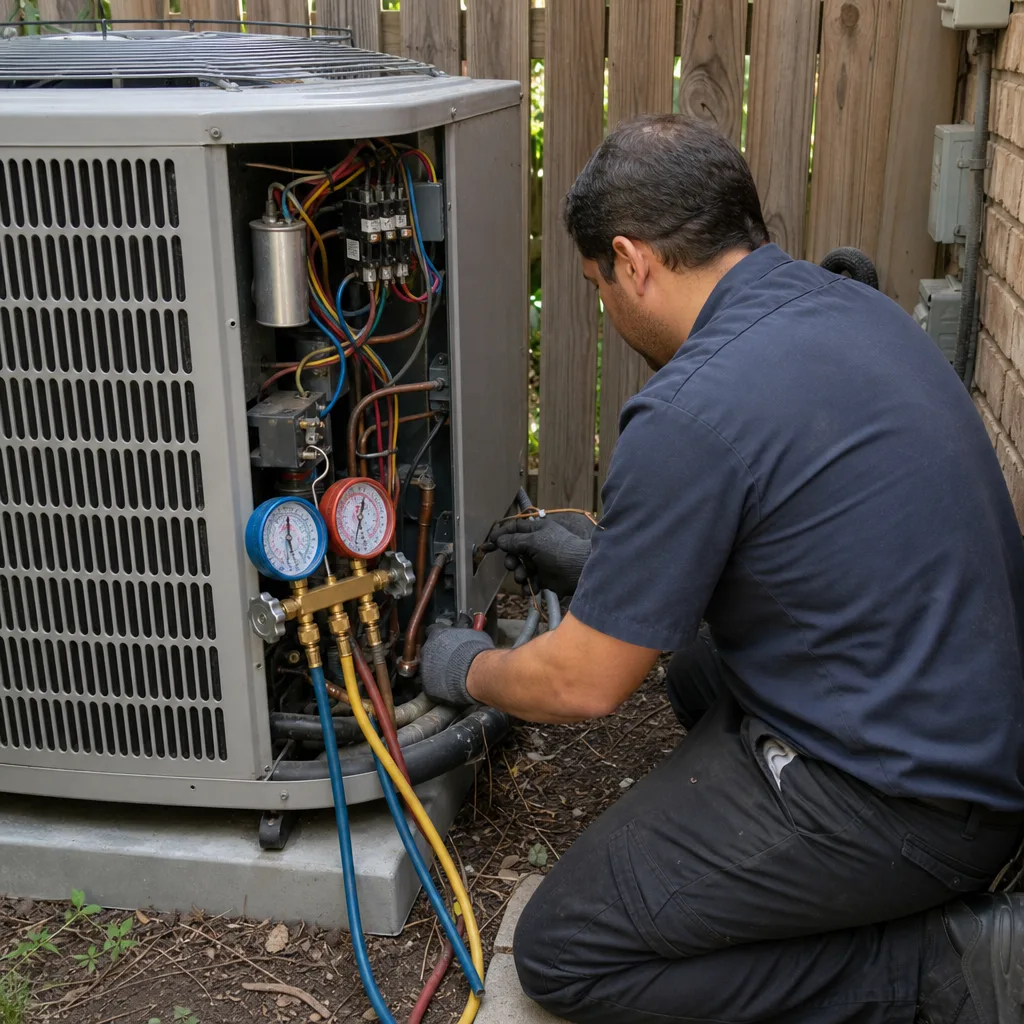
 AC repair
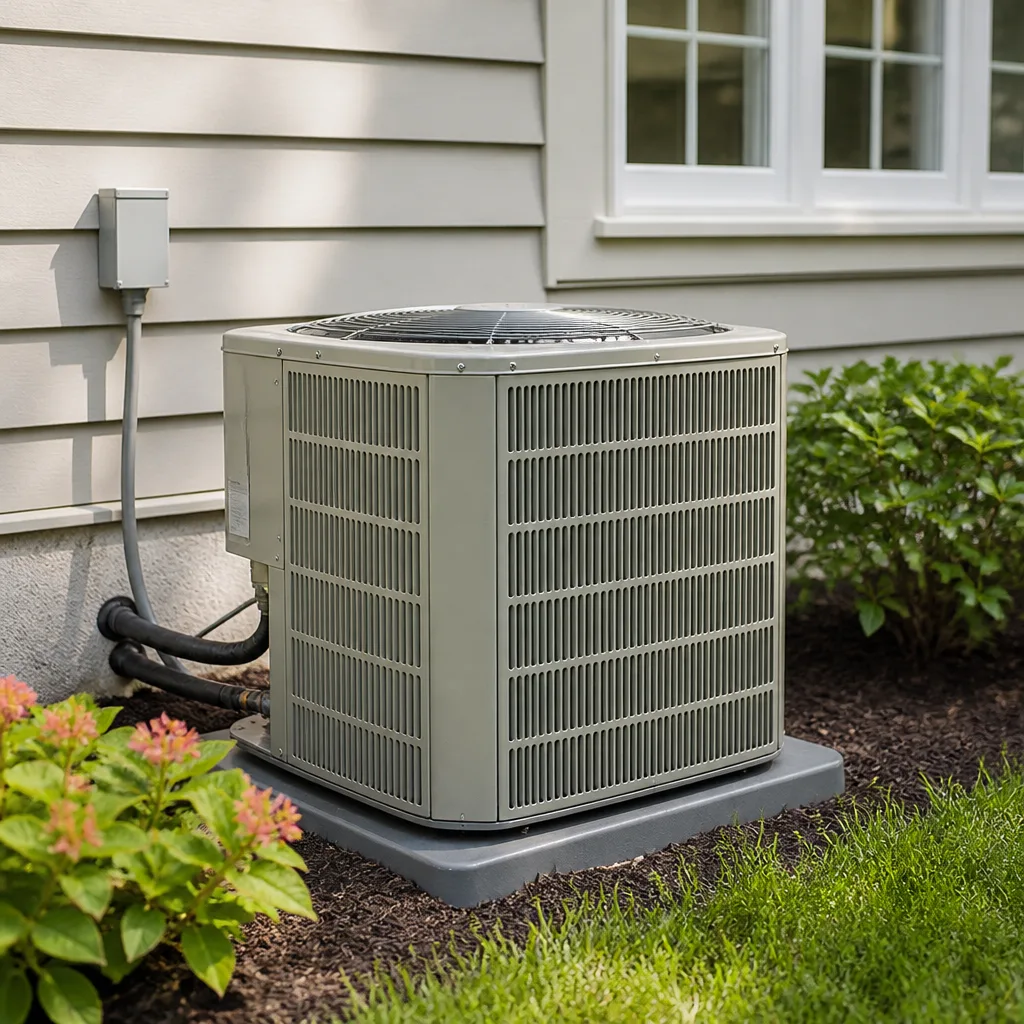
 Furnace & heating
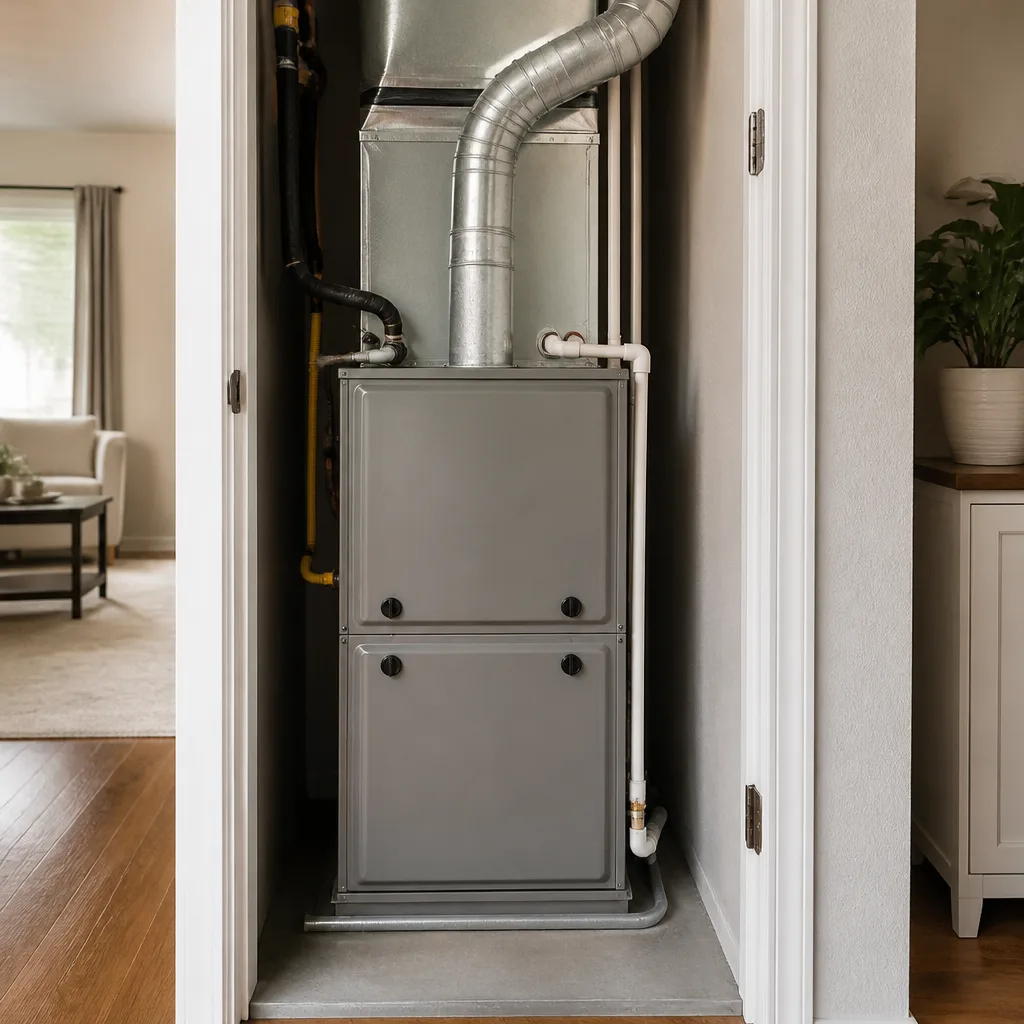
 Heat pumps
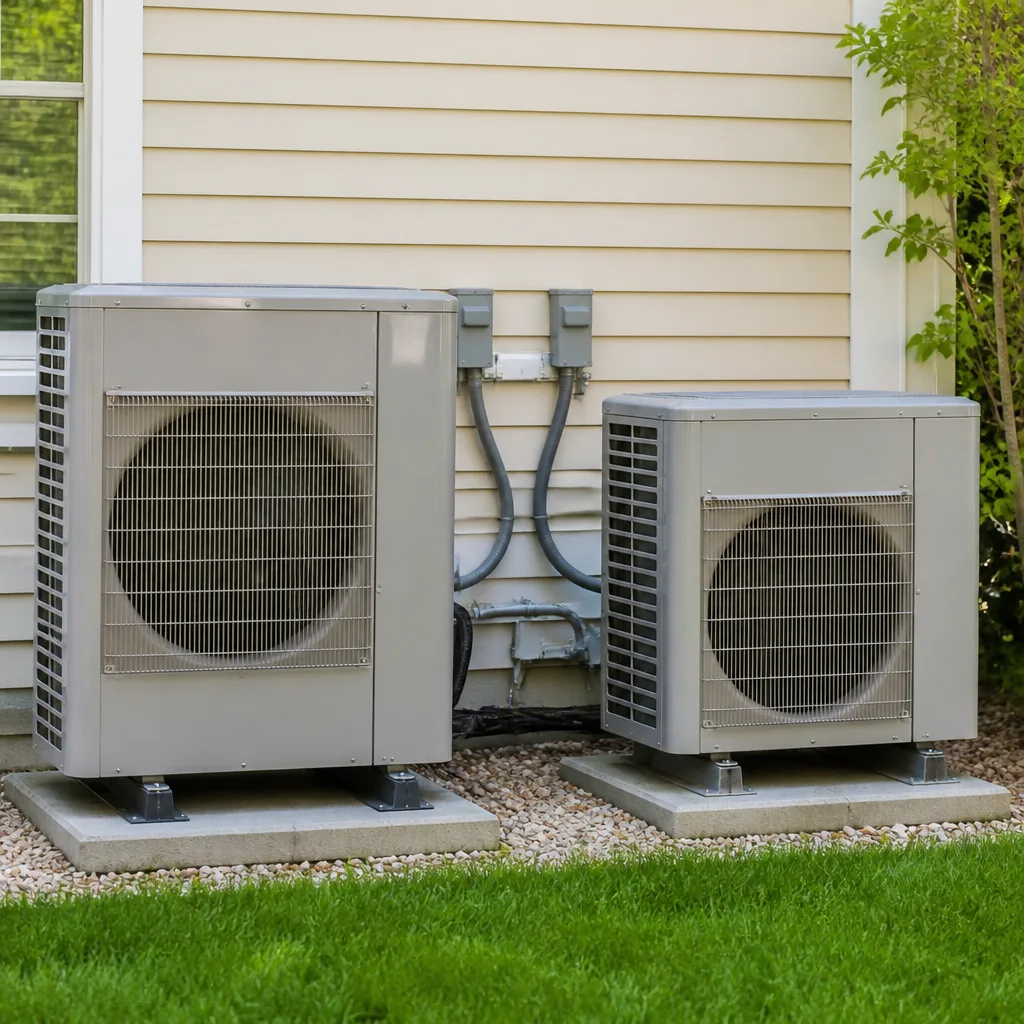
 Ductless mini splits
 Carrier
 Trane
Trane Goodman
Seasonal tune-up and full diagnostic on your Carrier, Trane, or Goodman system - readings shown to you before any repair is proposed
Diagnosis first, numbers second - you approve the repair price before a single part goes in.
Get your free estimateDIY vs Professional HVAC: The Dallas Homeowner’s Decision Guide
Replacing your own capacitor in Dallas is legal, costs about $25 in parts, and takes roughly 20 minutes with a decent YouTube video. Adding refrigerant to that same system is a federal EPA violation carrying a $44,539 per-day fine. Most homeowners can’t tell you where that line sits. This guide draws it clearly. You’ll learn exactly which HVAC tasks Texas law allows you to do yourself, which ones void your Carrier or Trane warranty, which ones can land you in real legal trouble, and which ones are simply not worth the risk during a Dallas August when your attic is 140 degrees and every HVAC company in the metroplex is booked three days out. By the end, you’ll know precisely when to grab a screwdriver and when to pick up the phone.
Quick Answer
DIY HVAC work in Dallas makes sense for five specific maintenance tasks: filter replacement, condensate drain flushing, thermostat swapping, outdoor unit cleaning, and float switch resets. Anything involving refrigerant, electrical components beyond a capacitor swap, gas lines, or compressor work crosses into territory that requires an EPA 608 certification or a Texas Department of Licensing and Regulation (TDLR) contractor license. The line isn’t just about legality. It’s about warranty protection, insurance liability, and what happens when your DIY fix fails during a 105°F week with a three-day service backlog across the metroplex. If a task carries no legal or warranty risk and you feel genuinely comfortable doing it, do it. If it involves refrigerant, gas, or sealed system components, call a licensed pro.
Styles & brands we work with
Table of Contents
- The Legal Line: What Texas and Federal Law Actually Say
- The Warranty Trap: How DIY Repairs Void Manufacturer Coverage
- Five DIY HVAC Tasks Every Dallas Homeowner Should Know
- What DIY Repairs Actually Cost in Dallas (And What Pros Charge)
- When DIY Creates Liability: Rentals, Home Sales, and Insurance Claims
- How to Evaluate a YouTube Repair Video for Dallas-Specific Accuracy
- The 5-Question Framework for Deciding DIY vs Professional
The Legal Line: What Texas and Federal Law Actually Say
Texas stops short of requiring a state contractor license to work on HVAC equipment that is not being offered for public sale or service. A homeowner can legally repair their own system, and an unlicensed handyman can tinker with it under certain narrow conditions. But federal law draws a hard line at anything involving refrigerant. Under Section 608 of the Clean Air Act, the EPA requires anyone opening a sealed refrigeration system to hold a current EPA 608 certification. That means adding R-410A to a low system, recovering refrigerant from a unit before disposal, repairing a leaking coil, or replacing a compressor. The fine structure is aggressive. The EPA carries authority to assess civil penalties up to $44,539 per violation per day, and in cases involving knowing violations, criminal prosecution is on the table. In our experience serving homeowners across Dallas from Oak Cliff to Far North Dallas, most people are genuinely surprised to learn that “topping off” the refrigerant in their own condenser is a federal offense, not a DIY gray area.
Texas also regulates electrical work. While the state carves out a homeowner exemption for residential work on your own primary residence, that exemption does not extend to duct work, gas piping, or any modification to a fuel-burning appliance. Furnaces in Dallas, especially older units in homes around Lakewood and East Dallas, can have gas valve issues that look simple on video but involve live natural gas and carbon monoxide risk. TDLR does license HVAC contractors for work beyond the homeowner exemption, and any work on a rental property you own but do not occupy personally typically falls outside the exemption entirely.
Here is the boundary, plainly stated:
- Legal for homeowners in Dallas to do themselves: filter replacement, thermostat replacement (low-voltage wiring only), condensate drain flushing, outdoor coil cleaning with water and approved cleaners, capacitor replacement in many cases, float switch reset, breaker reset, and general cleaning.
- Requires EPA 608 certification, no exceptions: adding or removing refrigerant, opening any refrigerant line, replacing evaporator coils, condenser coils, compressors, or expansion valves, leak testing with refrigerant, and recovering refrigerant from any system.
- Requires a TDLR-licensed contractor in most rental or commercial scenarios: gas furnace repair involving the gas valve, manifold, or burners, duct modifications, any work on a property you own but do not live in, and any repair being done in connection with a sale or transaction where the work must meet code.
- Gray area where the risk is mostly practical, not legal: replacing a capacitor (legal in most homeowner exemptions but carries electrical shock risk), replacing a contactor, and swapping a condensate pump. These are legal but genuinely dangerous if done wrong.
The practical takeaway for Dallas homeowners: if the task involves a screwdriver, a garden hose, a shop vacuum, or a $25 part from an HVAC supply house, you are probably within your rights. If it involves manifold gauges, a recovery tank, a nitrogen regulator, or anything with a gas line attached, you have crossed into licensed territory. And if you are ever unsure, AC repair in Dallas is a call away, and the person on the other end can tell you over the phone whether your issue sounds like a legal DIY fix or a licensed-only job.
The Warranty Trap: How DIY Repairs Void Manufacturer Coverage
The legal risk of certain DIY HVAC work is real but rare. The warranty risk is neither rare nor hypothetical, and it is where Dallas homeowners lose the most money without ever realizing it. Every major manufacturer writes its warranty documents to protect itself from liability, and those documents contain specific language about who may service the equipment. Carrier, for instance, states in its warranty terms that damage resulting from “improper installation, application, service, or maintenance” is excluded from coverage. Trane uses similar language, excluding failures caused by “repairs or modifications made by anyone other than a qualified service technician.”
Here is the trap: a warranty exclusion does not just void the part you touched. It can void coverage on the entire system. We have seen Dallas homeowners replace a $15 capacitor, cross the wrong terminals, fry the control board, and then learn that the $900 board replacement is not covered because their own work caused the failure. The manufacturer does not need to prove negligence. It needs only to show that unqualified work was performed on the system, and the failure is plausibly connected. In practice, manufacturers rarely fight this hard on small claims, but on a failed compressor in a 4-year-old Carrier Infinity system, a $4,000 repair bill, and a service record showing a homeowner opened the electrical panel, the warranty denial is almost automatic.
Specific warranty language worth knowing:
- Carrier: Warranty does not cover “damage or failure resulting from: improper installation, application, service, or maintenance; modification of the original product; or use of unapproved parts or accessories.”
- Trane: Excludes failures caused by “repairs, alterations, or modifications performed by anyone other than a licensed HVAC contractor or qualified service technician.”
- Lennox: Requires that warranty service be performed by “a licensed HVAC contractor” and states that “failure to provide proof of professional maintenance may limit coverage on certain component failures.”
The warranty calculation changes depending on where your system is in its lifecycle. A system in its first five years, still under comprehensive parts coverage, is not the one to learn capacitor replacement on. A 14-year-old Goodman unit with no remaining warranty is a different equation entirely. The financial risk of a DIY repair is directly proportional to how much warranty you have left to lose. Before you touch anything, find your serial number, call the manufacturer or check online, and confirm exactly what your warranty still covers. If the answer is “a lot,” the smart Dallas move is to protect that coverage with documented professional service.
The nuance that gets missed: some warranty language permits homeowner maintenance like filter replacement and basic cleaning without voiding coverage. No manufacturer will deny a claim because you changed your own air filter. The exclusions target component-level repairs, electrical work, and anything involving the refrigerant circuit. Keep your DIY work to maintenance, not repair, and your warranty stays intact.
Five DIY HVAC Tasks Every Dallas Homeowner Should Know
These five tasks are safe, legal, warranty-friendly, and genuinely useful for any Dallas homeowner. They require no special tools beyond what most households already have, and they save real money over time.
1. Filter Replacement
The single highest-ROI maintenance task in HVAC. A dirty filter in a Dallas summer forces your system to work against restricted airflow, raising evaporator coil temperatures and driving up runtime. During peak cooling season, monthly filter checks are appropriate for most homes, especially if you have pets or live near construction. The filter size is printed on the existing filter frame. Purchase a MERV 8 to MERV 11 filter for most residential systems. Higher MERV ratings filter more particles but restrict airflow on systems not designed for them. This is a 2-minute task with zero risk. The cost is $8 to $20 per filter. Do this one without hesitation.
2. Condensate Drain Flush
Dallas humidity, especially from May through September, produces gallons of condensate daily. Every air conditioner pulls moisture from indoor air, and that water drains through a PVC line to either a floor drain, a sink connection, or outside the home. Algae and mold grow inside that drain line, especially in warm, dark conditions that never fully dry out. A blocked condensate drain triggers the float switch, which shuts down the entire system to prevent water damage to ceilings and walls. This is the most common no-cooling call we see in older Dallas homes.
Flushing the drain is simple. Locate the primary drain line near the indoor air handler, which in many Dallas homes is in the attic or a utility closet. Pour one cup of white vinegar or a 50/50 vinegar-water solution into the drain line access point or the P-trap cleanout. Let it sit for 30 minutes. Then flush with clean water. Doing this every 60 to 90 days during cooling season prevents most clogs. If the line is already blocked, a wet/dry shop vacuum on the outside drain outlet will often pull the clog free. This task is safe, costs pennies, and takes 10 minutes.
3. Thermostat Replacement
Replacing a thermostat on a standard single-stage system is a low-voltage electrical task that Texas law allows for residential homeowners, and manufacturers do not void warranties for thermostat swaps. The key constraint is wiring compatibility. Old Dallas homes with 4-wire setups can be trickier, especially when upgrading to a smart thermostat that requires a C-wire for continuous power. Many modern smart thermostats include a PEK adapter for 4-wire systems, but you need to read the instructions carefully and verify compatibility before buying. Take a photo of your old thermostat wiring before removing anything. That photo solves 90% of the confusion that leads to a no-heat or no-cool situation. The task takes 30 to 45 minutes and costs $50 to $300 depending on the thermostat you choose.
4. Outdoor Unit Cleaning
Your condenser unit sits outside in Dallas heat, surrounded by cottonwood, oak pollen, grass clippings, and dust. When the coil fins become clogged with debris, the system cannot reject heat efficiently, pressures rise, and compressors work harder and hotter. The result is higher electric bills and a shorter system lifespan.
Proper cleaning is simple: turn off power at the breaker or the exterior disconnect box, remove the outer cabinet screws (usually 8 to 10), lift the top and fan assembly carefully, and use a garden hose with a spray nozzle to rinse the coil from the inside out. Use water pressure no higher than a standard garden hose, and never use a pressure washer, which bends the coil fins and permanently impairs performance. If the fins are badly caked, use an approved foaming coil cleaner from any HVAC supply store or big-box retailer. Rinse thoroughly, let the unit drain for 30 minutes, then restore power. Full cleaning takes about an hour and costs under $20 in supplies. Do this every spring in Dallas, and mark it on your calendar every year.
5. Resetting a Tripped Float Switch
If your system shuts down in the middle of a humid Dallas night, the culprit is often a float switch rather than a major mechanical failure. The float switch is a small safety device mounted in or near the condensate drain pan. When the drain line backs up and water rises in the pan, the float rises and opens the circuit, shutting the system down to prevent water from spilling through your ceiling. Dallas homeowners with attic-mounted systems should know exactly where this switch is and how to recognize a tripped float.
To reset, first inspect the drain pan and determine why the float tripped. If the pan is full, the drain is blocked, and resetting the float without clearing the clog will result in the same shutdown within hours. Clear the clog first using the drain flush method above, then reset the float mechanism. Some float switches reset automatically once the water recedes, while others require a manual reset button or a rocker switch. If the pan is empty and the switch is tripped anyway, it may be a faulty component with a simple replacement cure. This is a 15-minute diagnostic task that costs nothing if you can clear the clog yourself.
What DIY Repairs Actually Cost in Dallas (And What Pros Charge)
The DIY-vs-professional conversation usually starts with cost, and for good reason. Understanding what a task actually costs helps you decide whether the risk is worth the savings. Here are real Dallas market numbers and what affects them.
- Capacitor replacement: DIY cost $15 to $40 for the part. Professional cost $150 to $300 including the part, diagnostic, and labor. The savings are real, but the risk is shocking yourself, damaging the control board from miswiring, or causing a compressor failure that costs thousands. If you know which wire goes where and have a multimeter to verify the old capacitor’s rating, DIY is reasonable. If you are guessing, do not.
- Condensate drain flush: DIY cost under $5. Professional cost $90 to $200 as part of a maintenance visit. This is a pure win for DIY.
- Condensate pump replacement: DIY cost $60 to $120 for the pump if the old one is accessible and you can match the specs. Professional cost $250 to $450 including labor and disposal. The tricky part with DIY is wiring the new pump’s safety switch into the system. If you are not confident with low-voltage wiring, the professional cost is worth it.
- Thermostat replacement: DIY cost $50 to $300 for the thermostat and zero labor. Professional cost adds $100 to $250 in installation fees. DIY is usually the right choice here if you can navigate the wiring.
- Refrigerant recharge: There is no legal DIY option. The refrigerant for most Dallas residential systems (R-410A) costs $40 to $80 per pound wholesale, and a typical low system needs 2 to 6 pounds. Professional cost ranges from $180 to $600 depending on how low the system is. More importantly, a system that needs refrigerant has a leak, and adding refrigerant without finding and fixing the leak is a temporary fix at best. The EPA 608 certification requirement makes this a professional-only task, full stop.
- Compressor replacement: There is no DIY option. This is a $1,800 to $3,500 professional repair on a residential unit in Dallas, and it requires refrigerant recovery, brazing, nitrogen purging, vacuum, and recharging. Attempting this without EPA certification and proper equipment is both illegal and practically impossible. More often, a failed compressor on a system over 10 years old points toward full system replacement rather than component repair.
The honest math: DIY saves real money on maintenance tasks. It saves almost nothing on repair tasks once you account for the tools you need to buy, the trip to the supply house that may not sell to unlicensed individuals anyway, the risk of catching a 240-volt shock, and the possibility of turning a $200 problem into a $2,000 problem. Pro-level repairs cost more because they carry a written guarantee, which we’ll get to.
When DIY Creates Liability: Rentals, Home Sales, and Insurance Claims
Liability is where the DIY-vs-professional question shifts from “can I save money?” to “am I creating a legal problem for myself?” Three specific scenarios in Dallas deserve attention.
Rental Properties
The Texas homeowner electrical exemption applies to your primary residence, not to property you own and rent out. If you own a rental home in Dallas and you perform electrical repair on the HVAC system, you are operating outside the homeowner exemption. If a tenant is injured, or if a fire starts, your insurance company has grounds to deny the claim, and you may face personal liability. Beyond the legal question, Texas law requires landlords to maintain habitable conditions, and air conditioning is functionally essential in Dallas. A failed AC in July is not a nuisance, it is a habitability issue that can trigger a tenant’s legal remedies. For rental properties, professional HVAC work is not a preference, it is a compliance obligation.
Pre-Sale Home Inspections
When a Dallas home goes under contract, the buyer’s inspector will examine the HVAC system. If the inspector flags non-professional repairs, modified wiring, or components that do not meet current code, you may be forced to pay for professional remediation before the sale closes. Homeowners who DIY’d a furnace repair five years ago and forgot about it discover this at the worst possible time, when they have no leverage and a closing deadline. The cost of remediation during escrow often exceeds what a professional repair would have cost originally.
Insurance Claims
Most Dallas homeowner policies cover sudden and accidental HVAC damage, including lightning strikes, power surges, and certain types of mechanical failure through equipment breakdown coverage. But insurers inspect damaged equipment before paying claims. If the adjuster finds evidence of unprofessional repair or modification, the claim can be denied on the grounds that the damage was not sudden and accidental but rather the result of improper work. This applies even when the DIY work was done years before the failure and involved a different component. Insurers look for reasons not to pay, and unlicensed repair work is a ready-made reason.
The principle here is straightforward: in any scenario where your HVAC work is subject to inspection by an insurer, an attorney, a city code inspector, or a buyer’s contractor, you want a paper trail from a licensed professional. In scenarios where no one will ever inspect the work and the risk is entirely practical, the DIY question resolves on savings and safety alone. Furnace repair in Dallas involving gas components is the clearest example of the latter: whatever you save by attempting it yourself is dwarfed by the potential cost of getting it wrong.
How to Evaluate a YouTube Repair Video for Dallas-Specific Accuracy
YouTube repair videos are the modern homeowner’s apprentice manual, and many of them are genuinely good. The problem is that most are filmed in basements in Ohio or garages in Arizona, neither of which looks like a Dallas HVAC installation. Half the advice in a typical HVAC video breaks down under Dallas-specific conditions, and knowing what to look for saves you from following the wrong procedure for your actual system.
1. Check the air handler location
Most Dallas homes do not have basements. Air handlers and furnaces go in attics, utility closets, or occasionally garages. A video filmed in a basement with an upflow furnace and a floor drain does not translate cleanly to an attic horizontal installation. Drain geometry works differently in horizontal units, which changes the float switch setup and the way you access the evaporator coil. If the video shows a vertical furnace in a basement and your unit is a horizontal attic unit, find a different video.
2. Watch for flex duct versus rigid duct
Dallas homes built since the 1980s almost universally use flex duct, the insulated, accordion-style ducting that runs through attics. Many DIY videos assume rigid sheet metal ducts, which function differently for airflow, sealing, and repair. If a video tells you to repair a duct leak with sheet metal screws, that advice is for a different system than the one in most Dallas homes.
3. Consider the humidity
A video from Arizona can tell you all about sensible heat load, a topic that means something different in Dallas. Our summers combine heat with humidity that creates much higher latent load, which changes how the system should be charged, what thermostat settings make sense, and how often the drain system needs attention. A video that does not mention humidity is giving you incomplete advice for a Dallas system, especially on any topic involving temperature split, airflow, or thermostat setting.
4. Assume code differences
HVAC installation codes vary by municipality, and Dallas requirements differ from what a video filmed elsewhere assumes. This matters most on electrical disconnects, condensate drain termination, gas piping clearance, and emergency shutoff requirements. A procedure that is code-compliant in one state may not be in Texas. If a video instructs you to do something that would be inspected by a city official, verify the code requirement locally before following the video.
5. Look for the safety section
Any competent HVAC video about electrical work begins with a lockout-tagout procedure, the standard practice of killing power at the breaker, locking it off, and verifying with a meter that wires are cold. If a video skips this or tells you to “just be careful,” it is not a video you should trust. The same applies to videos about gas components. Any video about a furnace gas valve that does not mention shutting off the gas supply and checking for leaks is dangerously incomplete.
For every Dallas homeowner, these five evaluation checks take 30 seconds and will save you from following dangerous advice. They matter more than the video’s view count, upload date, or production quality. A poorly shot video by a Texas HVAC tech who understands attics is worth more than a slickly produced video by someone who has never seen a horizontal system in a 140-degree attic.
The 5-Question Framework for Deciding DIY vs Professional
If you remember nothing else from this guide, remember these five questions. Walk through them in order, and the DIY-vs-professional decision will answer itself for almost any HVAC task.
- Does this task involve refrigerant, gas, or sealed system components? If yes, the decision is made: professional only, no exceptions, under federal law. This includes refrigerant recharge, coil repair, compressor work, and gas valve replacement.
- Is my system still under manufacturer warranty? If yes, DIY component-level work risks voiding that warranty. The value of the remaining warranty is the amount you are gambling. Systems under 5 years old typically still carry substantial parts coverage. Systems over 12 years old rarely do.
- Would this work be inspected or reviewed by an insurer, a buyer, a tenant, or a code official? If yes, you want professional documentation. This applies to rental properties, homes under contract, and insurance claims. The legal and financial exposure of a DIY trail is not worth the savings.
- Is the risk of getting it wrong mostly financial or mostly physical? A botched drain flush costs you nothing but time. A botched electrical repair can kill you or burn your house down. Electrical work, including capacitor swaps, carries a physical risk that deserves respect. If the worst-case scenario is death or house fire, the professional cost is insurance, not labor.
- Do I actually want to do this, or do I want to save money? Be honest with yourself. Some homeowners genuinely enjoy understanding and maintaining their systems, and for those people, the five DIY tasks above are rewarding. But if you are doing a repair you hate, on a component you do not understand, to save $100, the math rarely makes sense. Your time, your safety, and your system’s lifespan are all worth something.
Common Mistakes to Avoid
- Topping off refrigerant without a leak check. A system low on refrigerant has a leak, and adding refrigerant without finding the leak is both illegal for a homeowner and financially wasteful. The refrigerant will leak out again, usually within weeks. This is the most expensive common mistake we see in Dallas.
- Ignoring the difference between the homeowner electrical exemption and rental property law. Your primary residence is one thing. A rental property is another, and the legal distinction matters more than most landlords realize.
- Believing a video marketer’s claim that “anyone can do this.” Some HVAC repair videos are made by licensed techs who want to share knowledge. Others are made by content creators who have never held a gauge manifold and are chasing views. The safety section test above filters most of the bad ones.
- Using a pressure washer to clean an outdoor unit. We mentioned this earlier, but it bears repeating because the mistake is so common and so destructive. Bent coil fins never straighten themselves, and a bent-fin coil loses efficiency permanently.
- Replacing a component with the wrong spec part. Capacitors, contactors, and thermostats come in different ratings, and the difference matters. A capacitor with the wrong microfarad rating can cause compressor damage. A thermostat wired for the wrong system type can cause short cycling. Match the part number, or do not proceed.
- Skipping the breaker shutoff before opening a panel. Every year, homeowners are injured because they assumed the outdoor disconnect was the only power source when the indoor breaker was still feeding the system. Kill both. Verify with a meter. Then work.
See the difference
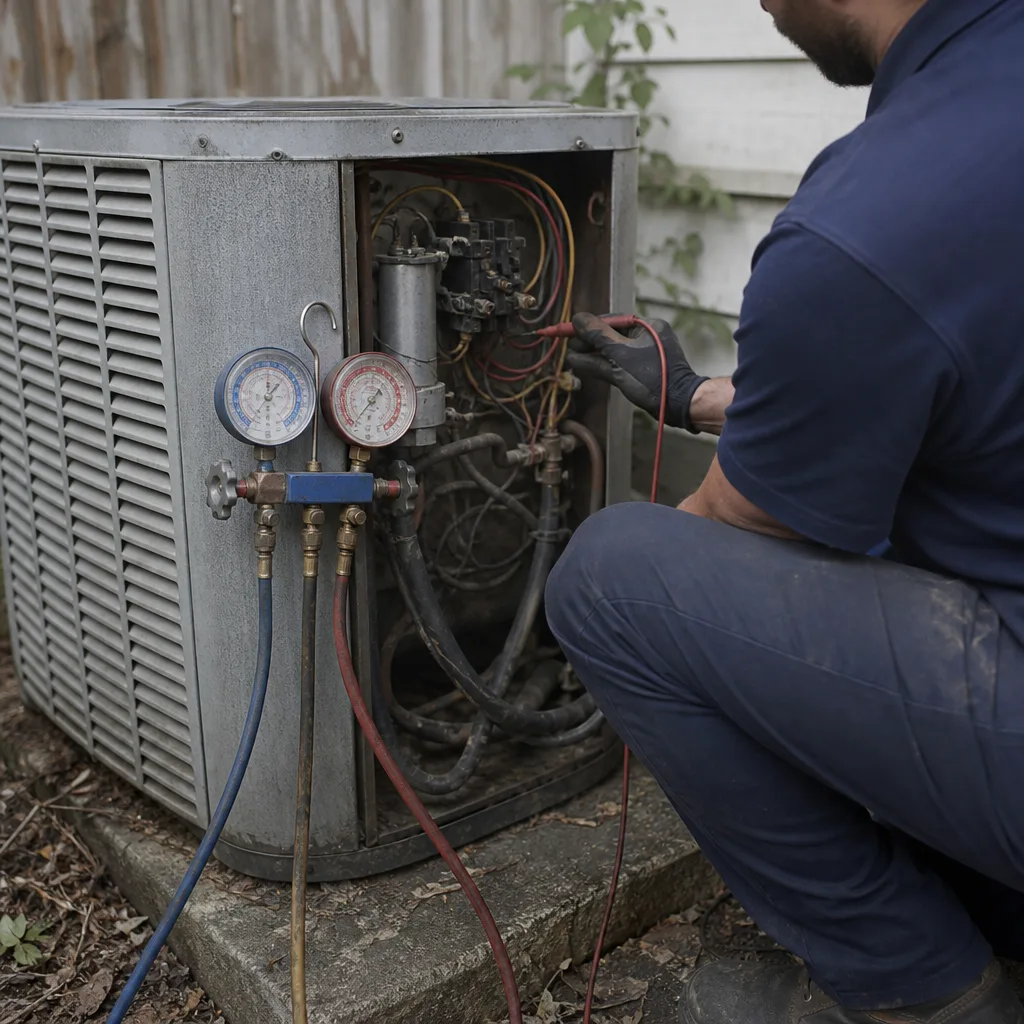 Before
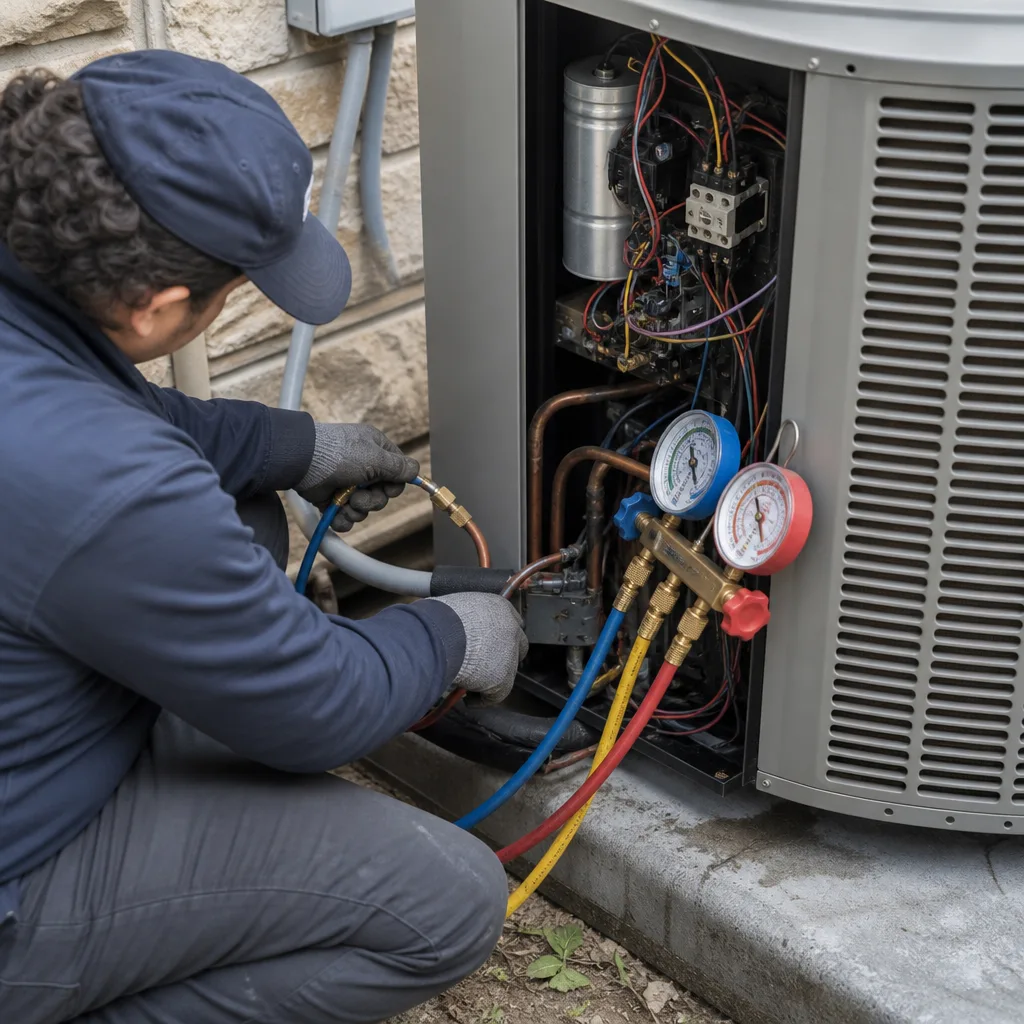 After
After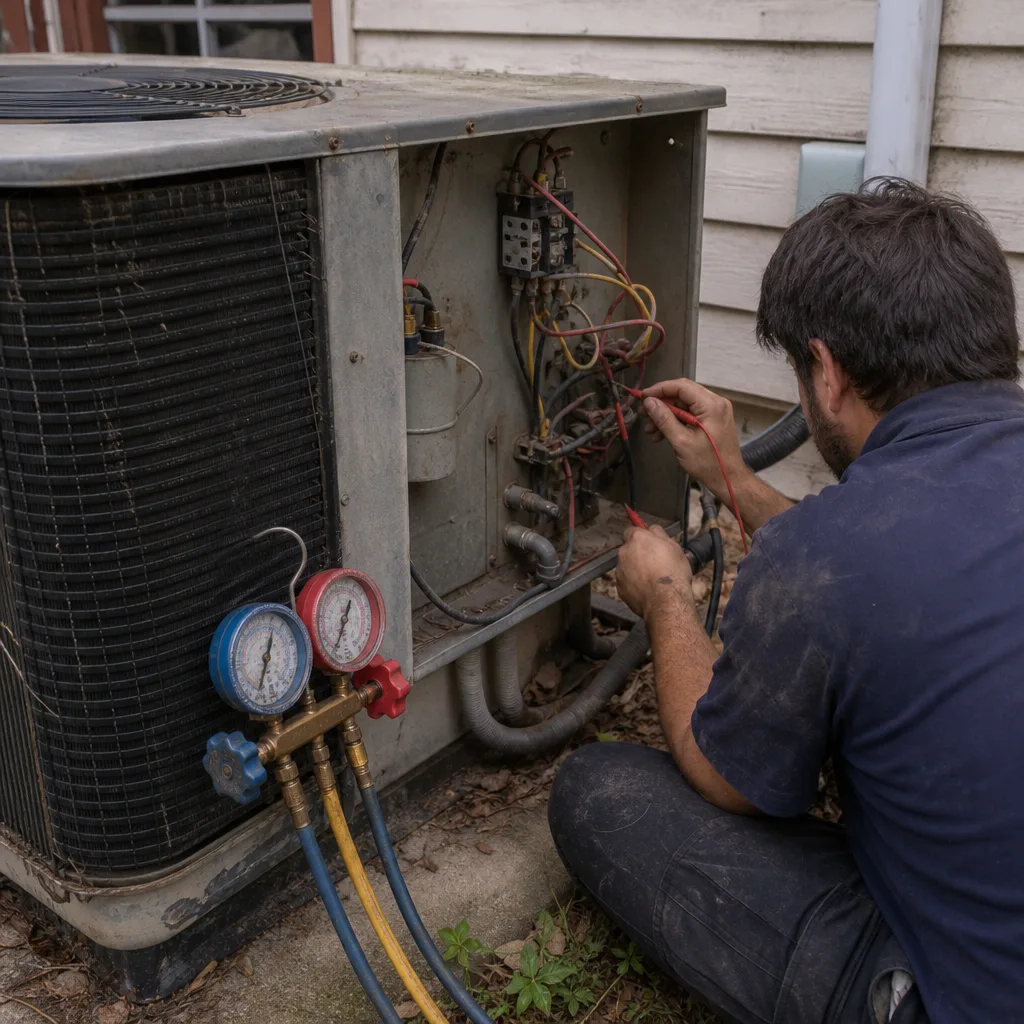 Before
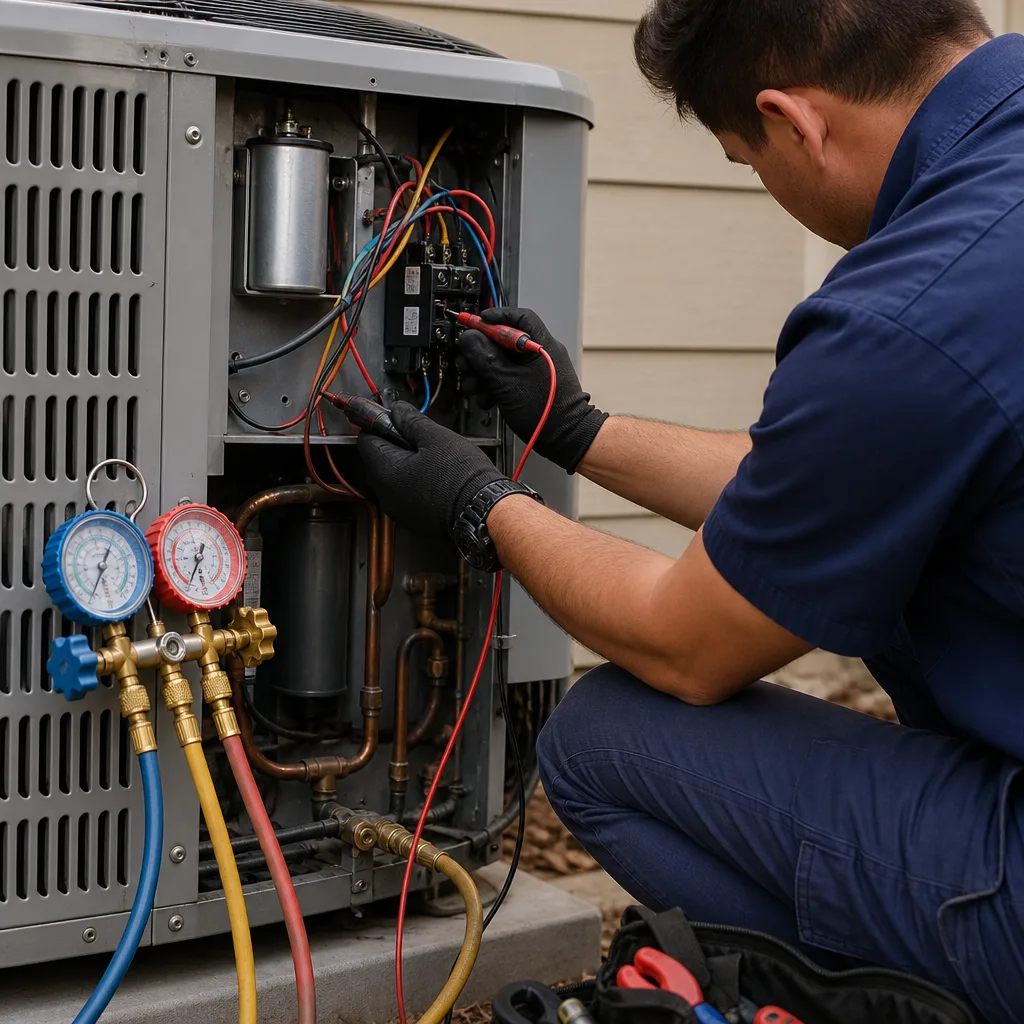 After
After Before
 After
AfterWhen to Call a Professional
Call a professional any time the task involves refrigerant, gas, or sealed system components. Call one when your system is under warranty and a component-level repair is needed. Call one when the work will be inspected or documented. Call one when the risk of getting it wrong is physical rather than financial. And call one when you have already tried the simple fixes, the system is still down, and the Dallas forecast says 103. A system failure during extreme heat is not a learning opportunity, it is a health risk, especially for older adults, infants, and anyone with respiratory or cardiac conditions. In those moments, speed matters more than any savings calculation.
For everything that requires professional work in Dallas, we are glad to help. Our AC maintenance in Dallas covers the seasonal tune-up work that keeps your system out of the emergency category in the first place, and our repair work starts with a written price before any work begins. The Brandt HVAC Co Dallas home page has the details on who we are and how we work, from the verified identity of the technician at your door to the 365-Day Done Right Promise on every repair. The name Brandt comes from an old word for a firebrand, a fitting root for work that keeps a Dallas home warm in January and cool in July.
Frequently Asked Questions
Is it legal to repair my own AC in Texas?
Yes, with significant limits. Texas allows residential homeowners to perform many repairs on their own primary residence, including filter replacement, thermostat replacement, and certain component swaps. But any task involving refrigerant requires an EPA 608 certification regardless of property type or homeowner status, and work on a rental property falls outside the homeowner’s main exemption. If your repair involves refrigerant, gas, or sealed system components, professional help is not optional.
Will DIY work void my AC warranty?
It can, depending on the manufacturer and the nature of the work. Carrier, Trane, and Lennox warranty documents all contain language excluding failures caused by improper service by unqualified individuals. Maintenance tasks like filter replacement will not affect warranty coverage, but component-level electrical repair or any refrigerant system work by an unlicensed person can void coverage on the entire system. Check your specific warranty terms and confirm remaining coverage before doing non-maintenance DIY work.
What is the EPA 608 certification, and why does it matter?
EPA Section 608 certification is a federal credential required for any person who opens, services, or handles refrigerant in an HVAC system. It matters because the Clean Air Act carries civil penalties of up to $44,539 per day per violation for working with refrigerant without certification. Homeowners are generally prohibited from purchasing refrigerant without proof of certification, and there is no legal gray area for topping off a low residential system. If the system is low on refrigerant, an EPA-certified technician is required to handle it.
How much does an HVAC repair cost in Dallas compared to DIY?
DIY maintenance costs are consistently low: under $20 for filter replacement, under $5 for drain flushing, and under $30 for coil cleaning on average. DIY repairs save less. The same repair performed by a professional typically costs $150 to $600 for common fixes like capacitor or condensate pump replacement, and $1,800 to $3,500 for component work like compressor replacement or coil repair. The professional cost includes labor, parts, and a written guarantee. When a repair fails without a guarantee, the second fix is not free, and that is the hidden cost that often wipes out DIY savings.
Can a landlord do their own HVAC repair on a rental property in Dallas?
Legally, no. The Texas residential electrical and HVAC exemption applies to a homeowner’s own residence, not to tenant-occupied property. A landlord performing electrical repair on a rental property is operating outside the exemption and faces both regulatory and insurance liability if something goes wrong. Beyond the legal question, a failed AC in a Dallas rental during summer triggers habitability requirements and tenant legal remedies. Professional, documented HVAC work is the only defensible choice for rental properties.
Should I repair or replace my Dallas HVAC system?
The answer depends on the age of the system, the cost of the repair, and the warranty status. A good rule of thumb is to multiply the repair cost by the system’s age in years. If that number exceeds $5,000, replacement usually makes more financial sense than repair. In practice, for a Dallas home with a 12-year-old system and a $2,000 compressor failure, replacement is the stronger option. For a 6-year-old system with a $300 capacitor failure, repair is clearly right. Your service professional can run the specific numbers for your equipment and your home, and for an exact quote, call (325) 312-3269 for a free estimate.
The Bottom Line
The DIY-vs-professional HVAC question in Dallas comes down to one principle: know the line, and stay on the right side of it. On the DIY side are maintenance tasks that are safe, legal, warranty-friendly, and genuinely valuable to know, like filter replacement, drain flushing, and outdoor coil cleaning. On the professional side are repair tasks involving refrigerant, gas, sealed systems, and any work where an insurance company, a home inspector, or a tenant relationship is involved. That line is not arbitrary. It comes from federal EPA law, Texas licensing requirements, and manufacturer warranty language that carries real financial consequences. If you stay on the maintenance side of the line, you will save money and extend the life of your system. If you cross it, the risk is not just a failed repair, it is a warranty denial, an insurance problem, or a federal fine. Make the choice with the line in sight, and you will rarely regret the call.
Written by Devin Marlowe, Owner at Brandt HVAC Co Dallas, serving Dallas since 2003.